Meekness on the Court

Joel Rohde

To learn about what is truly important to a society one simply needs to look at their budget and their calendar.  Where do they spend their money and where to they spend their time?  According to a 2017 study by WinterGreen Research, youth sports are a 15.3 billion dollar industry. The Aspen Institute tells us that on average, students in America spend 11.5 hours each week participating in a sport. The most committed students will spend up to 60 hours in a week participating in functions associated with their sport while it’s in season.  It is easy to see that youth sports hold significant influence in our society.

The weight of importance we have assigned to youth sports should cause us to pause and question what value is being gained from them and what part they should play in the education of our students. 

Morning Star Academy is concerned with teaching students to view all of life in light of Christ’s Kingdom.  Education is not simply passing on knowledge from one generation to the next, but rather cultivating the affections of students so that they will live virtuous lives.  If youth sports have been woven deeply into the world our students are being raised in, how should Morning Star teach students to view them in light of the Gospel of Jesus?

Affections are learned and ordered in our routines, practices, and habits.  I’ve had the opportunity to coach 5th and 6th grade boys’ basketball at Morning Star for 6 years.  Most people would point to teamwork and self-esteem as being some values gained from basketball.  I believe that while those things are important, basketball gives us a unique opportunity to instill an affection for meekness.

Meekness is strength under control.  It is the ability to put our trust in God and commit ourselves to His will.  It allows us to cast our cares on Him and wait patiently for His will to be done.  When we do this we don’t succumb to quick flashes of anger.  Instead we allow God to control the situation.  In James 3:13 we read about the “meekness of wisdom” that teaches us to be slow to speak, quick to listen, and open to correction.

Basketball, like life, is a training ground for meekness.  Those who have great power and the ability to control it reflect a gift that comes from God. Blessed are the meek, for they shall inherit the earth.  That is a trophy worth playing for.


Joel Rohde serves as pastor of worship and discipleship at North Ridge Community Church in Eldridge. He has a deep love for the the church and Classical Christian Education. Joel coaches fifth and sixth grade students at Morning Star Academy and is committed to using the sport as a tool to guide students toward a life of discipleship and service in God’s Kingdom.


Telling the Story at Home

Anna Carrington

“Tell me a story from when you were a kid?!” my sons like to ask. I don’t have as many high school shenanigans to re-play as my husband does, so I often punt to him. He’ll tell them about the time his buddy threw a whole pizza out the sunroof and it landed right back in the driver’s seat … or the time he and his friend took Josh’s grandma’s convertible through a car wash … or the time …

Our kids clamor for stories. On the surface, it’s just for giggles. But under all the fun they show their longing for belonging. Your stories become their stories. This is the principle at work in Deuteronomy when Moses commands the Israelites to “Remember the Lord your God who brought you out of Egypt.”

This ancient story of deliverance was the Israelites’ story. In Christ, it is our story too. Advent – the four weeks leading up to Christmas – is a precious opportunity to tell The Story to our sons and daughters. As Pam Rhode reminds us, our Christmas preparations involve a posture of watching and waiting for the Hope of the Ages. Last year our family assembled a Jesse Tree to trace The Story through the Old and New Testaments. It consisted of paper ornaments hung on a vertical strip of garland. It was not very complicated, and the kit included Scripture readings for each day of Advent. This gave us the opportunity to explore different books of the Bible together.

Through this daily rhythm, I realized that while training our sons to “think” about what God has done in Christ is central, there are truths they will “catch” just by the very act of gathering after supper and pinning up scraps of paper. (James K.A. Smith explores this power of habit in You Are What You Love, which Morning Star faculty read together in 2016.)We could call it habit, rhythm, or liturgy. A life of devotion means routinely giving praise to God. We bring a sacrifice of praise not once, but evening by evening.

Because Jesus is Emmanuel, “God with us,” a regular family devotional life together will reflect that reality as we gather in person. We might read a Psalm of praise, take turns offering prayers of thanksgiving and petition, or read aloud from a devotional book … yet all of these things do more than impart knowledge. Moms and Dads: Remember that our preparation and patience are critical elements of being present with our kids in this rhythm. We model life in Christ’s kingdom by what we do, not just by what we say.

So let your family’s Advent tradition of paper doors or ornaments or countdowns be a springboard into a new year of daily gatherings. The ordinary habits of your family life will form your child’s heart and remind them that The Story is not only true, it is beautiful. And it is daily bread.

Jesse Tree: https://www.rca.org/resources/jesse-tree-symbols-and-bible-stories

You Are What You Love:

Reading the Bible in Advent

Pamela Rohde

“I have seen all the things that are done under the sun; all of them are hevel, a chasing after the wind,” says the Teacher in Ecclesiastes 1:14.  Some versions of the Bible translate hevel as “meaningless” but it also carries the meaning “vapor.” That means all the things done on earth are vapor,  a breath that looks white and substantial as it’s released into the winter air, but is gone too quickly to be grasped.

Advent, which remembers thousands of years of God’s people longing for his salvation, begins four Sundays before Christmas day.  That means it invites us into over four weeks of anticipation and longing – that can be a tough sell in a commercial season of lights, sparkle, and cozy Christmas cheer.

We think of Christmas as a season filled with meaning, but the Teacher would say that our celebrations, too are hevel – quickly fleeting and often leaving us weary as we enter ordinary time.  Advent reminds us to be cautious about where we seek meaning by grounding us in the hope of the ages.

While Advent isn’t a biblically mandated observance, it is a valuable one.  It anchors us in the eternal plan of God rather than our fleeting Christmas traditions.  In Advent, we add our voices to those of God’s people awaiting his deliverance throughout time, and we remember our connection to his story of redemption.  As we read the Bible, we’re aware that the story of the Redeemer isn’t limited to the four gospels. Every book we read sings of Jesus. So we long for his coming alongside generations of believers, and we’re ready to burst with joy when we read in Galatians four:

“But when the set time had fully come, God sent his Son, born of a woman, born under the law, to redeem those under the law, that we might receive adoption to sonship.”

We rejoice in the coming of Jesus at the time God appointed.  However, our anticipation doesn’t end at the incarnation, but carries on in the already-but-not-yet spiritual reality of our current existence.  As Paul writes in Romans 8:23, the groaning of anticipation continues as we await the full expression of our redemption:

“Not only so, but we ourselves, who have the firstfruits of the Spirit, groan inwardly as we wait eagerly for our adoption to sonship, the redemption of our bodies.”

In Advent we don’t only re-live the eager waiting for the Messiah, we also live in confident hope and longing for Christ’s return.  We remember that the posture of a disciple, as Jesus tells us, is watchful expectancy.

So how do we approach the Bible in this Advent season?  This question is less about what we read than how we read it.

We read it slowly, leaning into the waiting, letting our hearts be shaped by the joyful – and sometimes painful – yearning for the second coming of the One we’re called to love with all our hearts, souls and strength.  We allow the frenzy of Christmas trappings to be stilled in the presence of the living Word of God.

We read it seeking greater knowledge of the Redeemer, a knowledge that moves beyond the intellectual to the intimately relational.  We ask how our Advent readings illuminate the character, qualities, and mighty acts of God made manifest in Jesus Christ. We grow in our adoration and love.

And finally, we read with assurance in his promises.  Remembering his faithfulness in the past, we cling confidently to his promises not to leave us as orphans (John 14:18) and to provide new strength (Isaiah 40:30) and rest for our souls (Matthew 11:29) as we wait for him to carry his good work to completion (Philippians 1:6).  We draw strength from the knowledge that nothing can separate us from his love (Romans 8:39) and live with missional intentionality as we pray along with the apostle John, “Come, Lord Jesus!”

Pam Rohde teaches Bible, worldview, and art at Morning Star Academy. She loves teaching in an environment where students are encouraged to grow not only in knowledge, but also discernment and discipleship. Pam and her husband, Joel, have four children at MSA.

“It’s Different Here”

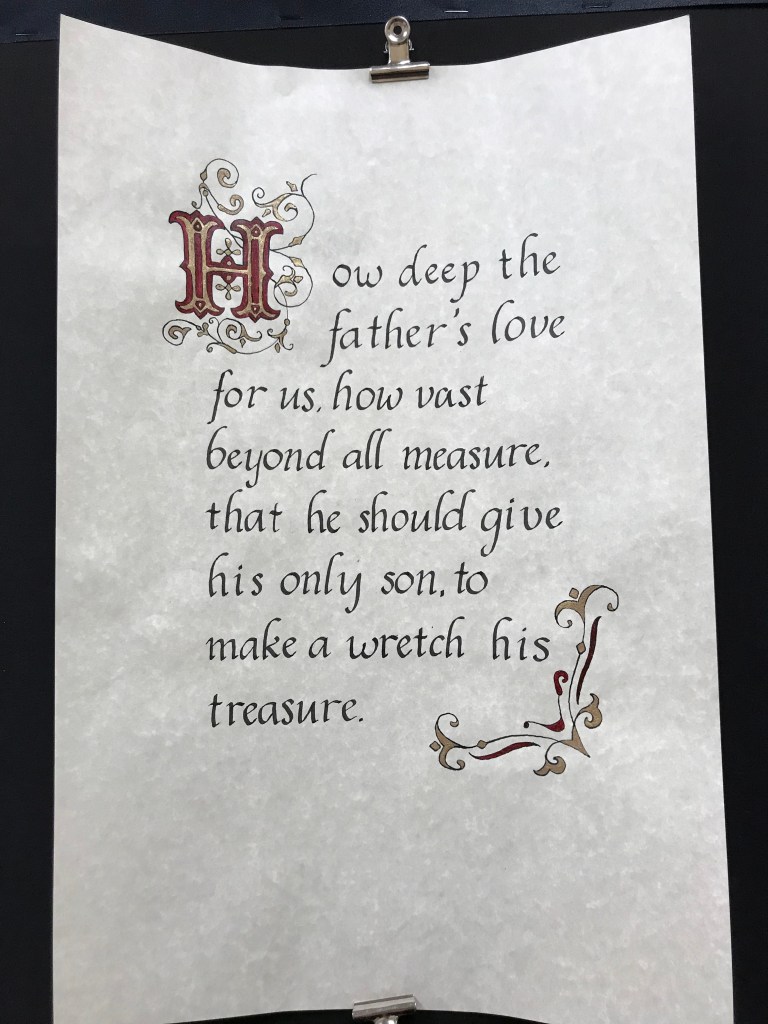
Calligraphy Art created by one of the upper school students of Morning Star Academy

Welcome to Morning Star Academy Writes: the new blog connecting families and faculty, staff and alumni through the power of story.

We wanted you to be the first to know about this new project, “It’s Different Here,” A weekly Advent blog series, slated to begin next week.

What to expect? Expect one post per week throughout the season of Advent.

When is Advent? It starts next week on Sunday, December 1st. (The blog posts will begin midweek, on Wednesday, December 4th.)

Why Advent? Advent is the four week season leading up to the celebration of Christmas and Christ’s birth. It is a time for reflection and contemplation – the lifting up of these humble characters of the Bible who made room in their homes, their lives, their hearts for God’s son to be born.

And not everyone observes Advent.

If you aren’t a person of faith, you might skip right to Christmas. But to do so is to miss out on the richness of God’s kingdom at work in the world.

We don’t want to miss out on anything God is up to – neither should you!

So Stay Tuned. Do you want to learn more about the community connected to this school? Do you know anyone who is looking for a Classical Christian education? If so, follow along with the Morning Star Academy Blog.

http://www.morningstaracademywrites.com